
0
item(s)
Cart is empty
|
Home
::
|
Extensor Tendons of the Forearm and Overuse Injuries
The extensor tendons of the forearm allow the wrist and fingers to extend, but repetitive gripping and wrist motion can sometimes irritate these tendons and lead to outer forearm discomfort.
Quick Answer:
The extensor tendons connect forearm muscles to the wrist and fingers and allow the hand to open and lift. Activities that involve repeated gripping, wrist extension, or forearm strain may irritate these tendons over time. This can sometimes lead to soreness or tightness along the outer forearm.
The extensor tendons connect forearm muscles to the wrist and fingers and allow the hand to open and lift. Activities that involve repeated gripping, wrist extension, or forearm strain may irritate these tendons over time. This can sometimes lead to soreness or tightness along the outer forearm.
Key Takeaways
- Extensor tendons connect the forearm muscles to the fingers and wrist.
- These tendons allow the hand to open and the wrist to lift.
- Repetitive gripping or wrist motion can irritate these tendons.
- Outer forearm soreness is often linked to overuse of these structures.
- Supporting circulation and muscle relaxation may help recovery.
Introduction
Forearm discomfort is often associated with repeated gripping, lifting, or wrist movement. Because the muscles that control the hand originate in the forearm, many daily tasks place stress on these structures.
Understanding what forearm pain is helps explain why irritation of the extensor tendons can develop during sports, work activities, or repetitive movement.
You may also want to understand:
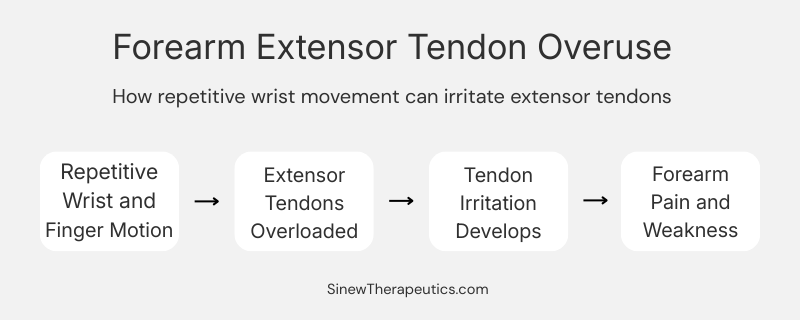
Diagram illustrating common steps used to support knee pain recovery including reducing strain, restoring movement, and supporting circulation in surrounding tissues.
What Are the Extensor Tendons of the Forearm?
The extensor tendons connect forearm muscles to the wrist and fingers.
These tendons allow the hand to open, the fingers to straighten, and the wrist to lift upward. Many everyday activities rely on this movement.
Because these tendons are used frequently throughout the day, they are especially vulnerable to irritation when repetitive strain occurs.
Why Repetitive Use Can Irritate These Tendons
Activities that involve repeated gripping or wrist movement can place continuous stress on the extensor tendons.
Over time, this repeated load may lead to soreness or tightness in the outer forearm.
- repeated gripping
- wrist extension
- lifting or pulling movements
- sports involving racquets or climbing
These movements activate the extensor muscles repeatedly, which can sometimes irritate the tendons that attach them to the hand.
Common Symptoms of Extensor Tendon Irritation
When these tendons become irritated, discomfort is usually felt along the outer forearm.
- aching in the outer forearm
- tenderness near the elbow
- tightness when gripping objects
- reduced grip strength
- discomfort when lifting the wrist
Activities That Often Stress the Forearm Extensor Tendons
Many sports and work activities involve repeated gripping or wrist motion.
- tennis or racquet sports
- weightlifting
- rock climbing
- tool use
- extended computer or mouse work
Topical Recovery Support
Topical therapies are commonly used to support recovery of muscles and connective tissue in the forearm.
For recent irritation or strain, some individuals apply Acute Sinew Liniment. In certain recovery routines, Sinew Herbal Ice may be used alongside the liniment to provide additional cooling support.
When soreness becomes more persistent or tissues feel tight, Chronic Sinew Liniment is sometimes applied. Some individuals also use a Sinew Injury Poultice together with the liniment to support deeper tissue relaxation.
Massage-based recovery routines may also incorporate Sinew Sports Massage Oil to help support circulation and muscle relaxation.
Safety Notes
This article provides general educational information about forearm tendon irritation.
Individuals experiencing severe arm injury, persistent swelling, or sudden loss of strength should consult a qualified healthcare professional.
Frequently Asked Questions
What do the extensor tendons of the forearm do?
They connect the forearm muscles to the fingers and wrist and allow the hand to open and the wrist to lift.
Why do these tendons become irritated?
Repetitive gripping, lifting, and wrist movement can place repeated stress on the tendons.
Where is extensor tendon discomfort felt?
Discomfort is usually felt along the outer forearm and sometimes near the elbow.
Can gripping activities cause forearm soreness?
Yes. Repeated gripping can strain the forearm muscles and tendons.
Related Articles in This Week’s Series
- What Is Forearm Pain?
- How the Forearm Muscles Work
- Who Gets Forearm Pain Most Often?
- What Causes Forearm Pain?
- How to Recover From Forearm Pain
- Common Myths About Forearm Pain
Related Recovery Tools
• Acute Sinew Liniment — topical support for fresh strain or irritation
• Chronic Sinew Liniment — used for persistent soreness and tight tissue
• Sinew Herbal Ice — cooling support often used with acute liniment
• Sinew Injury Poultice — traditional poultice used with chronic liniment
• Sinew Sports Massage Oil — massage-based muscle recovery support
• Acute Sinew Liniment — topical support for fresh strain or irritation
• Chronic Sinew Liniment — used for persistent soreness and tight tissue
• Sinew Herbal Ice — cooling support often used with acute liniment
• Sinew Injury Poultice — traditional poultice used with chronic liniment
• Sinew Sports Massage Oil — massage-based muscle recovery support