
0
item(s)
Cart is empty
|
Home
::
|
What Is Knee Pain? Causes, Symptoms, and What It Means
What Is Knee Pain?
Quick Answer:
Knee pain is discomfort or irritation felt in or around the knee joint that usually occurs when muscles, ligaments, tendons, cartilage, or surrounding tissues become strained, inflamed, or injured. It can result from overuse, sudden movement, poor biomechanics, or underlying joint conditions. While many cases improve with rest and care, persistent or severe knee pain may require medical evaluation.
Knee pain is discomfort or irritation felt in or around the knee joint that usually occurs when muscles, ligaments, tendons, cartilage, or surrounding tissues become strained, inflamed, or injured. It can result from overuse, sudden movement, poor biomechanics, or underlying joint conditions. While many cases improve with rest and care, persistent or severe knee pain may require medical evaluation.
Key Takeaways
- Knee pain refers to discomfort within or around the knee joint.
- It often occurs when soft tissues become irritated or inflamed.
- Overuse, strain, and biomechanical stress are common triggers.
- Knee pain can develop suddenly or gradually over time.
- Most mild cases improve with rest and supportive care.
Introduction
The knee is one of the largest and most frequently used joints in the human body. It supports body weight during walking, running, climbing stairs, and many everyday movements.
Because the knee absorbs significant force and movement, it is also one of the most common locations where people experience pain.
Knee pain is not a single condition but a symptom that can have many different causes. It may originate from muscles, tendons, ligaments, cartilage, or the joint itself.
Understanding what knee pain means is the first step toward identifying why it happens and how to manage it effectively.
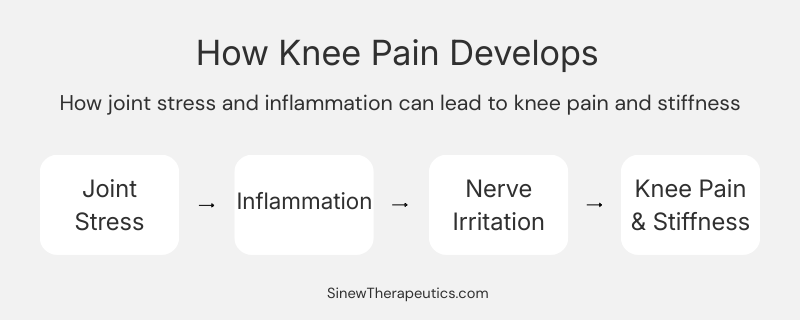
Diagram showing knee pain cycle from strain to inflammation and recovery
Understanding the Knee Joint
The knee joint connects the thigh bone (femur) to the shin bone (tibia) and allows bending, straightening, and stabilization of the leg.
This joint also includes important supporting structures such as:
- Ligaments that stabilize the joint
- Tendons that connect muscles to bone
- Cartilage that cushions movement
- Muscles that control motion
When any of these tissues become irritated or overloaded, the brain interprets this as pain.
Common Reasons Knee Pain Occurs
Knee pain usually develops when tissues experience more stress than they can comfortably tolerate.
Examples include:
- Sudden increases in physical activity
- Repetitive movements such as running or squatting
- Improper lifting mechanics
- Sports injuries
- Age-related joint changes
Inflammation is one of the body's natural protective responses when tissues are irritated or damaged.
This response may produce swelling, warmth, stiffness, and discomfort around the knee.
Some people also choose supportive topical products to help encourage circulation and comfort in the surrounding tissues. Sinew Therapeutics sports medicine products are designed to support soft tissue comfort during recovery and physical activity.
How Knee Pain Feels
Knee pain can feel different depending on which structures are affected.
People commonly describe sensations such as:
- A dull ache after activity
- Sharp pain when bending the knee
- Stiffness after sitting
- Swelling around the joint
- Pain when climbing stairs
Some individuals notice knee pain only during movement, while others may feel discomfort even at rest.
Common Misconceptions About Knee Pain
Many people assume knee pain always means serious joint damage.
In reality, many cases of knee pain are related to temporary soft-tissue irritation rather than permanent injury.
Another misconception is that pain automatically means activity should stop completely.
In many situations, controlled movement and gradual recovery strategies may actually help tissues heal.
When to Seek Medical Attention
Most mild knee discomfort improves with rest, gentle movement, and time.
However, medical evaluation may be important if:
- Pain follows a major injury
- The knee cannot bear weight
- Significant swelling appears quickly
- The knee locks or feels unstable
- Pain lasts several weeks without improvement
Persistent knee pain can sometimes indicate structural injury or underlying joint disease that requires professional care.
Safety Notes
This article provides general educational information about knee pain.
Anyone experiencing severe injury, inability to move the knee, or persistent swelling should seek evaluation from a qualified healthcare professional.
Frequently Asked Questions
What is the most common cause of knee pain?
Overuse, muscle strain, and inflammation of surrounding tissues are among the most common reasons people experience knee pain.
Can knee pain occur without injury?
Yes. Knee pain can develop gradually due to repetitive stress, poor biomechanics, or underlying joint conditions.
Is knee pain always related to arthritis?
No. Many cases of knee pain occur from soft tissue irritation, tendon strain, or temporary inflammation rather than arthritis.
Why does knee pain sometimes appear after exercise?
Exercise may temporarily increase stress on tissues that are not yet fully conditioned, leading to irritation or inflammation.
Does knee pain always require medical treatment?
Many mild cases improve with rest, activity modification, and supportive care, but persistent pain should be evaluated.