
0
item(s)
Cart is empty
|
Home
::
|
How to Recover From Knee Pain: Simple Steps to Support Knee Healing
Recovering from knee pain usually involves reducing irritation, supporting circulation, and gradually restoring normal movement so muscles, tendons, and connective tissues around the knee can heal.
Quick Answer:
Knee pain recovery typically focuses on reducing strain on the joint while supporting natural tissue healing. Rest, gentle movement, and circulation-supporting therapies are commonly used to help irritated muscles and connective tissue recover. Many people also apply topical liniments or cooling therapies to help soothe sore areas and relax tight tissues around the knee.
Knee pain recovery typically focuses on reducing strain on the joint while supporting natural tissue healing. Rest, gentle movement, and circulation-supporting therapies are commonly used to help irritated muscles and connective tissue recover. Many people also apply topical liniments or cooling therapies to help soothe sore areas and relax tight tissues around the knee.
Key Takeaways
- Knee pain recovery usually involves reducing irritation and restoring normal movement.
- Gentle activity often supports circulation and tissue healing.
- Topical therapies are commonly used to soothe sore muscles and connective tissue.
- Recovery time depends on the underlying cause of knee discomfort.
- Gradual return to activity helps prevent reinjury.
Introduction
Knee discomfort can develop after exercise, repetitive movement, sudden strain, or prolonged stress on the joint. Because the knee is responsible for supporting body weight during walking, running, and lifting, the muscles and connective tissues surrounding the joint can easily become irritated.
Understanding what knee pain is and the most common causes of knee pain can help explain why recovery focuses on reducing irritation while supporting natural tissue repair.
You may also want to understand:
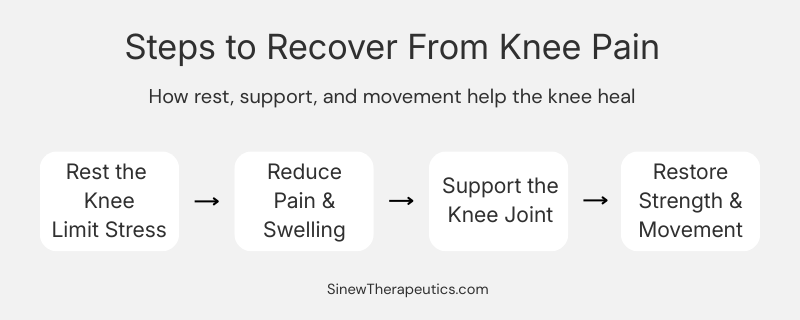
Diagram illustrating common steps used to support knee pain recovery including reducing strain, restoring movement, and supporting circulation in surrounding tissues.
Step 1: Reduce Stress on the Knee Joint
The first step in knee recovery is reducing activities that continue to irritate the joint.
This does not always mean complete immobilization. Instead, it often means temporarily modifying activities that place excessive pressure on the knee.
Examples include:
- limiting high-impact exercise
- avoiding repetitive bending or squatting
- taking breaks from prolonged standing
Reducing stress allows irritated tissues time to calm down and begin recovering.
Step 2: Maintain Gentle Movement
Light movement often helps support circulation and prevents stiffness during recovery.
When the knee remains completely inactive for long periods, surrounding muscles may tighten and joints may become stiff. Gentle walking or controlled mobility exercises can help keep tissues flexible.
Movement also helps deliver oxygen and nutrients to healing tissues.
Step 3: Support Circulation in Surrounding Muscles
Improving circulation in muscles surrounding the knee can help support recovery.
Massage, stretching, and topical therapies are commonly used to help relax tight tissues and encourage healthy blood flow.
Many people find that relaxing the quadriceps, hamstrings, and calf muscles helps reduce tension around the knee joint.
Step 4: Use Topical Therapies to Soothe Irritated Tissue
Topical treatments are often used to help soothe muscles and connective tissue surrounding the knee.
These therapies may create warming or cooling sensations that help relax tight tissue and support circulation.
Topical Recovery Support
Topical recovery methods are often incorporated into knee recovery routines to help soothe sore tissues and support circulation.
For recent strain or irritation, some individuals apply Acute Sinew Liniment. In certain recovery routines, Sinew Herbal Ice may be used alongside the liniment to provide cooling support after activity.
When soreness persists or tissues feel tight, Chronic Sinew Liniment is sometimes applied. Some people also combine it with a Sinew Injury Poultice as part of traditional recovery routines.
Massage-based recovery routines may also incorporate Sinew Sports Massage Oil to help support muscle relaxation and circulation.
Common Mistakes That Slow Knee Recovery
Some habits can unintentionally slow down knee recovery.
Examples include:
- returning to intense activity too quickly
- ignoring persistent swelling or stiffness
- avoiding movement for too long
Gradual recovery typically allows tissues to heal more effectively.
Safety Notes
This article provides general educational information about knee discomfort and recovery support.
Severe pain, sudden swelling, joint instability, or difficulty bearing weight should be evaluated by a qualified healthcare professional.
Frequently Asked Questions
How long does knee pain take to recover?
Recovery time varies depending on the cause of the discomfort. Minor muscle strain may improve within days or weeks, while more significant injuries may take longer.
Should you rest or move a painful knee?
Both rest and gentle movement are often helpful. Reducing intense activity while maintaining light movement can support circulation and prevent stiffness.
Can massage help knee pain?
Massage may help relax tight muscles surrounding the knee and support circulation in surrounding tissues.
Are topical treatments useful for knee discomfort?
Many people use topical therapies to help soothe sore muscles and connective tissues near the knee.
Can tight muscles cause knee pain?
Yes. Tight quadriceps, hamstrings, or calf muscles can increase stress on the knee joint and contribute to discomfort.
Related Articles in This Week’s Series
- What Is Knee Pain?
- How the Knee Joint Works
- Who Gets Knee Pain Most Often?
- What Causes Knee Pain?
- Does Liniment Help Knee Pain?
- Common Myths About Knee Pain
Related Recovery Tools
• Acute Sinew Liniment — topical support for fresh strain or irritation
• Chronic Sinew Liniment — used for persistent soreness and tight tissue
• Sinew Herbal Ice — cooling support often used with acute liniment
• Sinew Injury Poultice — traditional poultice used with chronic liniment
• Sinew Sports Massage Oil — massage-based muscle recovery support
• Acute Sinew Liniment — topical support for fresh strain or irritation
• Chronic Sinew Liniment — used for persistent soreness and tight tissue
• Sinew Herbal Ice — cooling support often used with acute liniment
• Sinew Injury Poultice — traditional poultice used with chronic liniment
• Sinew Sports Massage Oil — massage-based muscle recovery support