How the Knee Joint Works
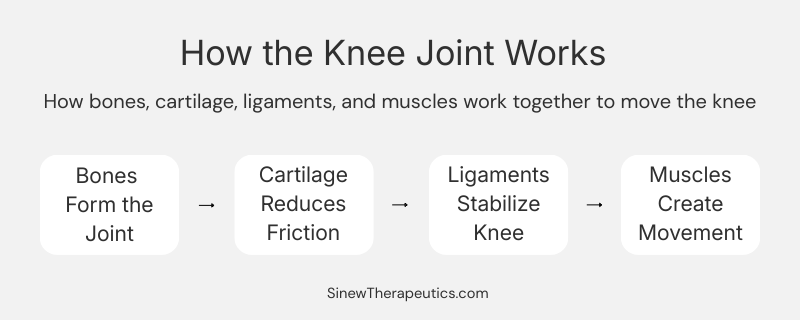
The knee joint works as a hinge-like structure connecting the thigh bone (femur) to the shin bone (tibia), allowing the leg to bend, straighten, and stabilize body weight during movement. It relies on ligaments, tendons, cartilage, and muscles to maintain stability while allowing controlled motion. When these structures experience excessive stress or imbalance, knee pain and inflammation may develop.
Key Takeaways
- The knee joint connects the femur, tibia, and patella to allow leg movement.
- Ligaments stabilize the joint and control motion.
- Cartilage cushions the bones and reduces friction.
- Muscles and tendons generate the force needed for movement.
- When knee mechanics become overloaded, pain and inflammation can occur.
Introduction
The knee is one of the most important joints in the human body because it allows people to walk, run, jump, squat, and climb. Nearly every lower-body movement relies on the knee joint working smoothly.
The knee must balance two essential roles: providing stability while allowing flexible movement.
Understanding how the knee joint works helps explain why certain activities sometimes lead to pain, strain, or inflammation.
The Bones of the Knee Joint
The knee joint forms where three major bones meet.
- Femur (thigh bone)
- Tibia (shin bone)
- Patella (kneecap)
The femur and tibia create the main hinge movement of the knee, while the patella helps improve the efficiency of the quadriceps muscles.
This structure allows the leg to bend and straighten while supporting significant body weight.
The Role of Cartilage
Cartilage acts as a protective cushion between bones inside the knee joint.
Two types of cartilage are important in the knee:
- Articular cartilage covering the ends of bones
- Meniscus cartilage acting as shock absorbers
These tissues reduce friction and distribute forces during walking, running, and jumping.
If cartilage becomes irritated or damaged, movement may become painful or restricted.
Ligaments That Stabilize the Knee
Ligaments are strong bands of connective tissue that hold the bones of the knee together.
The four primary knee ligaments include:
- Anterior cruciate ligament (ACL)
- Posterior cruciate ligament (PCL)
- Medial collateral ligament (MCL)
- Lateral collateral ligament (LCL)
These ligaments help control forward, backward, and side-to-side motion of the knee.
When ligaments are strained or injured, the knee may feel unstable or painful.
Muscles and Tendons That Move the Knee
Muscles surrounding the knee generate the force required for movement.
Key muscle groups include:
- Quadriceps muscles at the front of the thigh
- Hamstrings at the back of the thigh
- Calf muscles below the knee
Tendons connect these muscles to bones, allowing them to move the knee joint.
When muscles become tight, fatigued, or overworked, the stress on the knee joint can increase.
For individuals seeking additional support during physical activity or recovery, Sinew Therapeutics sports medicine products are designed to support soft tissue comfort and mobility.
Why Knee Mechanics Sometimes Lead to Pain
Knee pain often occurs when the balance between movement and stability becomes disrupted.
This can happen due to:
- Sudden increases in activity
- Improper lifting mechanics
- Muscle imbalances
- Repetitive motion
When tissues experience more stress than they can comfortably tolerate, irritation and inflammation may develop.
Safety Notes
This article provides educational information about knee joint mechanics.
Individuals experiencing severe knee injury, significant swelling, or persistent pain should consult a qualified healthcare professional.
Frequently Asked Questions
Is the knee a hinge joint?
Yes. The knee primarily functions as a hinge joint, allowing bending and straightening movements while maintaining stability.
What structures help stabilize the knee?
The ACL, PCL, MCL, and LCL ligaments stabilize the knee and control its movement.
Why is the knee vulnerable to injury?
The knee supports large forces during everyday activities and sports, which can strain its ligaments, tendons, and cartilage.
Do muscles affect knee pain?
Yes. Tight or weak muscles can increase stress on the knee joint and contribute to pain.
Can knee mechanics improve with exercise?
Proper strengthening and mobility exercises can help improve knee stability and reduce strain on surrounding tissues.


