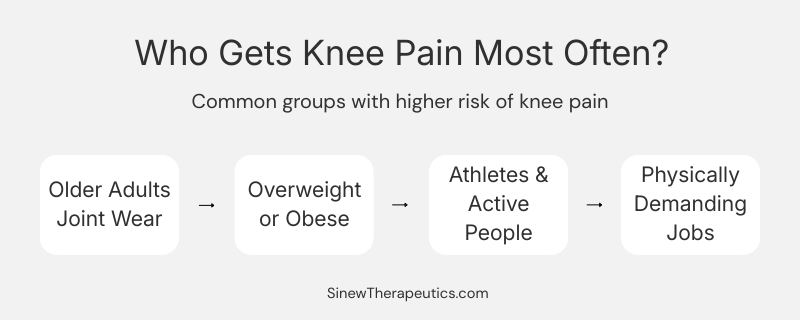
Who Gets Knee Pain Most Often?
Knee pain most commonly affects athletes, physically active individuals, workers who perform repetitive movements, and adults whose joints experience frequent stress. Activities such as running, lifting, climbing, and squatting place repeated pressure on the knee joint and surrounding soft tissues. When the knee experiences more strain than it can comfortably handle, irritation and inflammation may develop.
Key Takeaways
- Athletes and runners frequently experience knee pain due to repetitive stress.
- Workers who lift, kneel, or climb often place heavy loads on the knee joint.
- Muscle imbalance or poor movement mechanics can increase knee strain.
- Knee pain can develop gradually from repeated stress over time.
- Understanding risk factors helps people reduce strain on the knee.
Introduction
The knee joint plays a critical role in almost every lower body movement. Walking, climbing stairs, lifting objects, and exercising all require the knee to support body weight while allowing flexible motion.
Because the knee absorbs large forces during daily activities, it is one of the joints most commonly affected by pain or strain.
While knee discomfort can affect anyone, certain groups of people tend to experience knee pain more often because of the physical demands placed on their joints.
Athletes and Active Individuals
Athletes often experience knee pain because sports place repeated stress on the knee joint.
Activities such as running, jumping, and quick changes in direction require the knee to absorb large forces while maintaining stability.
Sports commonly associated with knee strain include:
- Running
- Basketball
- Soccer
- Tennis
- Weightlifting
Repetitive impact and sudden movements can irritate ligaments, tendons, and cartilage within the knee.
Workers in Physically Demanding Jobs
Many occupations place significant stress on the knee joint throughout the day.
Jobs that involve lifting, kneeling, climbing ladders, or working on uneven surfaces may increase knee strain.
Common examples include:
- Construction workers
- Warehouse workers
- Landscapers
- Mechanics
- Carpenters
Repeated bending and lifting can gradually increase stress on knee tissues, sometimes leading to discomfort or inflammation.
Adults With Muscle Imbalances
Muscle imbalance around the knee can increase strain on the joint during everyday movements.
For example, if the quadriceps muscles are much stronger than the hamstrings, the knee may experience uneven stress.
Similarly, tight hip muscles or weak glutes can alter walking mechanics and place additional pressure on the knee.
Over time, these imbalances may contribute to irritation of tendons or surrounding tissues.
People Increasing Activity Too Quickly
Knee pain sometimes develops when physical activity increases faster than the body can adapt.
Examples include:
- Starting a new workout routine
- Increasing running distance too quickly
- Returning to sports after time away
When tissues are not fully conditioned for new levels of activity, irritation and inflammation may develop.
For individuals seeking additional support during physical activity or recovery, Sinew Therapeutics sports medicine products are designed to support soft tissue comfort and mobility.
Why Understanding Risk Factors Matters
Recognizing who is more likely to develop knee pain helps people take steps to reduce strain before problems develop.
Preventive strategies often include improving movement mechanics, strengthening supporting muscles, and gradually increasing physical activity.
Small adjustments in training or work habits can significantly reduce stress placed on the knee joint.
Safety Notes
This article provides general educational information about knee pain risk factors.
Anyone experiencing severe knee injury, persistent swelling, or difficulty bearing weight should consult a qualified healthcare professional.
Frequently Asked Questions
Do runners get knee pain often?
Yes. Runners frequently experience knee discomfort because running places repeated impact forces on the knee joint.
Are workers more likely to develop knee pain?
People who perform repetitive lifting, kneeling, or climbing often experience increased stress on the knee joint.
Can muscle imbalance cause knee pain?
Yes. Imbalances between muscle groups surrounding the knee can alter movement patterns and increase joint stress.
Why does knee pain appear when starting exercise?
When activity levels increase too quickly, muscles and connective tissues may become irritated before they adapt to the new workload.
Is knee pain always related to injury?
No. Many cases develop gradually due to repetitive stress or muscle imbalance rather than a single injury.


